
Control and Coordination
Control and Coordination 📘
This blog explains "Control and Coordination" for Class 10 students preparing for CBSE and competitive exams like NEET and foundation for JEE/UPSC biology basics. We'll cover the nervous and endocrine systems, how signals travel, common examples, diagrams described for easy revision, quick revision boxes, common mistakes, and exam strategy tips. Read on to master concepts and score well.
Overview: What is control and coordination? 🧠➡️🦴
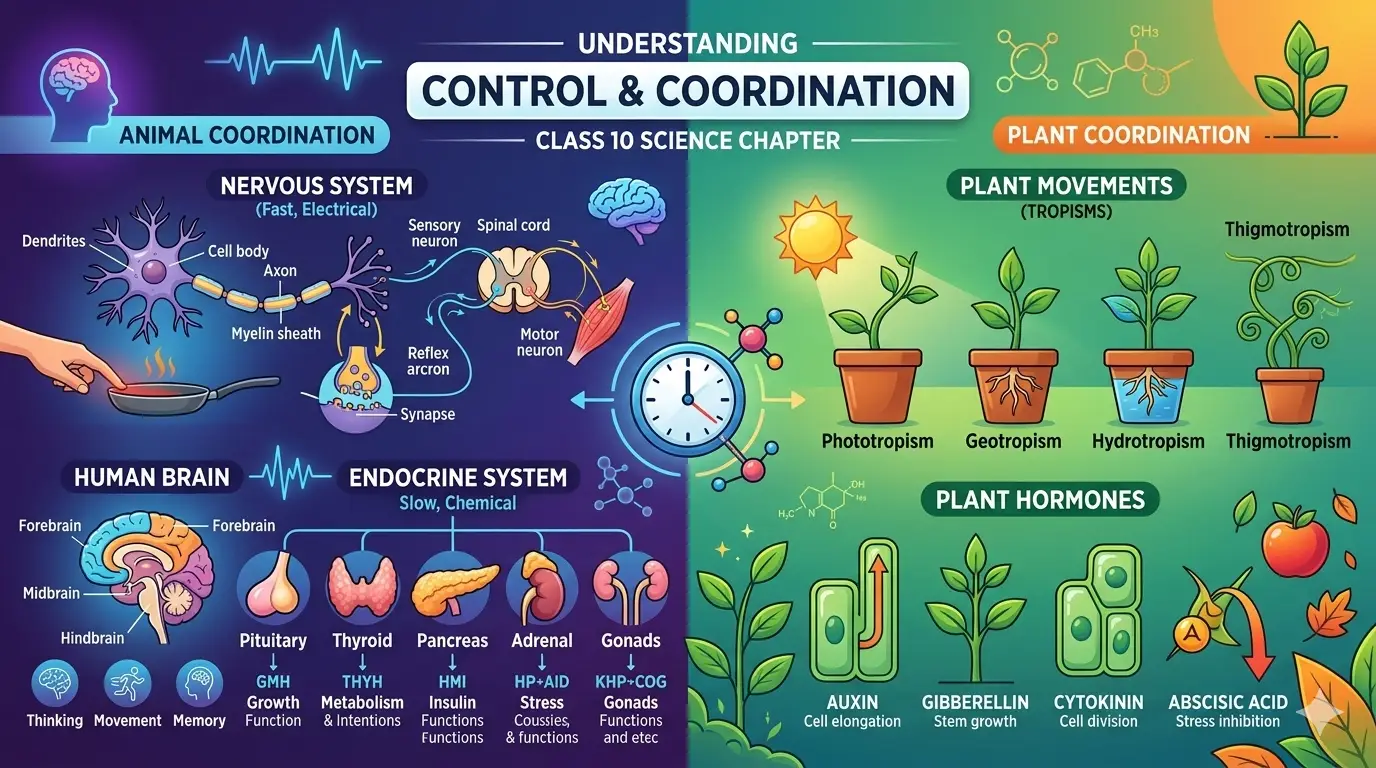
Control and coordination refer to the processes by which organisms sense changes in the environment (external and internal), process that information, and bring about a suitable response. In animals, it mainly involves two systems:
- Nervous system — fast, uses electrical impulses, ideal for quick responses (e.g., withdrawing hand from hot surface).
- Endocrine system — slower, uses chemical messengers (hormones) released into the blood, ideal for long-term regulation (e.g., growth, metabolism).
Nervous System: Structure and signal flow ⚡️
The nervous system consists of the brain, spinal cord (central nervous system, CNS) and peripheral nerves (peripheral nervous system, PNS). Key cellular unit: the neuron (nerve cell).
Neuron — parts and functions 🧩
Describe the neuron's major parts:
- Cell body (soma): has nucleus and organelles.
- Dendrites: receive signals from other neurons.
- Axon: conducts electrical impulse away from soma.
- Myelin sheath: fatty insulation produced by Schwann cells in PNS — speeds up impulse transmission.
- Synapse: junction between neurons; chemical neurotransmitters cross the synaptic cleft.
How an impulse travels — stepwise process 🔁
Process explanation (concise steps):
- Stimulus activates sensory receptor.
- Sensory neuron carries impulse to CNS (spinal cord or brain).
- CNS processes information — may involve interneurons in reflex arcs or brain processing for complex responses.
- Motor neuron carries response signal to effector (muscle/gland).
- Effector produces response (muscle contraction or secretion).
Reflex Action vs Voluntary Action ✋🤔
Understanding this difference is crucial for exams:
- Reflex action — automatic, fast, involves simple neural pathway (reflex arc) through spinal cord; brain may receive information later (e.g., knee-jerk, withdrawal from pain).
- Voluntary action — initiated and controlled by brain, slower and involves thought processing (e.g., writing, solving problems).
Endocrine System: Hormones and their roles 🧪
The endocrine system consists of glands that secrete hormones directly into the blood. Hormones regulate long-term processes such as growth, reproduction, metabolism, and water balance.
Major endocrine glands and functions
- Pituitary gland (master gland) — controls many other glands, growth hormone affects height.
- Thyroid gland — regulates metabolism (thyroxine).
- Adrenal glands — produce adrenaline for 'fight-or-flight' response.
- Pancreas — insulin and glucagon regulate blood sugar.
- Gonads (ovaries/testes) — sex hormones for reproduction and secondary sexual characteristics.
How hormones act
Hormones travel through blood to target organs where they bind to specific receptors and change cell activity — slower but long-lasting compared to nervous impulses.
Integration: Nervous and Endocrine Systems Working Together 🤝
Some activities need both systems — e.g., response to stress: nervous system triggers immediate actions via nerves (adrenaline), while endocrine system ensures longer-term changes through hormonal release (cortisol).
Process Spotlight: Reflex Arc — detailed walk-through 🔬
Step-by-step (useful for diagrams in exams):
- Stimulus (e.g., hot object) activates receptor in skin.
- Sensory neuron transmits impulse to spinal cord.
- Interneuron in spinal cord processes and sends impulse to motor neuron (no brain involvement for speed).
- Motor neuron activates muscle to withdraw hand.
- Brain later receives the sensory information — you then feel pain consciously.
Common Mistakes Students Make ❌
- Confusing hormones with enzymes — hormones are chemical messengers transported in blood; enzymes catalyze biochemical reactions.
- Thinking reflex actions involve the brain — reflex arcs bypass the brain for speed.
- Assuming all endocrine effects are immediate — many hormonal effects are slow and long-lasting.
- Mixing up adrenal glands with pancreas — adrenal produces adrenaline; pancreas regulates blood glucose.
Quick Revision Box ✅
- Neurons: dendrite → cell body → axon → synapse.
- Reflex arc sequence: Receptor → Sensory → Interneuron → Motor → Effector.
- Endocrine glands: Pituitary (master), Thyroid (metabolism), Pancreas (blood sugar), Adrenal (adrenaline), Gonads (sex hormones).
- Speed: Nervous = fast, short-lived; Endocrine = slow, long-lasting.
- Examples: Knee-jerk (reflex), Maintaining blood glucose (endocrine).
Important Terms to Remember (Flashcard style) 💡
- Synapse — gap between neurons where neurotransmitters act.
- Myelin sheath — insulating layer increasing conduction speed.
- Hormone — chemical messenger secreted by endocrine glands.
- Effector — muscle or gland responding to motor neuron.
Exam Strategy and Tips for Class 10 / CBSE / NEET Foundations 📝
- Diagram practice: Draw and label a neuron, reflex arc, and a simple hormone pathway (e.g., insulin action). Diagrams often fetch marks.
- Answer structure: Define → Explain → Example. For biology, include a short example or real-life application to score higher.
- Use keywords: neurotransmitter, receptor, myelin, pituitary, insulin, adrenaline.
- For NEET/competitive foundation, ensure understanding of diabetes, thyroid disorders, and mechanism of action for hormones as these are frequent concepts.
Short Practice Questions (with hints) 🧪
- What is the function of the myelin sheath? (Hint: think speed)
- How does adrenaline prepare the body for 'fight-or-flight'? (Hint: heart rate, blood flow, energy release)
- Explain how insulin and glucagon maintain blood sugar level. (Hint: storage vs release)
Memory Tricks and Timelines for Quick Recall ⏱️
Try this timeline-style memory ladder for endocrine effects:
- Immediate (seconds): Adrenaline — increases heart rate and breathing.
- Minutes to hours: Insulin release after a meal — glucose uptake and storage.
- Days to years: Growth hormone — affects height over developmental years.
Common Exam Questions and How to Approach Them 🔎
1. Draw and label the reflex arc — label receptor, sensory neuron, interneuron in spinal cord, motor neuron, effector. Short explanation of each step.
2. Differentiate between endocrine and nervous systems — make a two-column pointwise table in answers: medium (blood vs nerves), speed, duration, type of signal, examples.
3. Explain how insulin controls blood sugar — describe when blood sugar is high (after meal), pancreas secretes insulin, cells take up glucose, liver converts glucose to glycogen for storage.
Real-Life Applications and Relevance to Competitive Exams 🏥
- Understanding control and coordination is foundational for physiology questions in NEET. Disorders like diabetes, hyperthyroidism, and Addison's disease are common themes.
- CBSE Class 10 frequently asks definitions, diagrams, and simple processes — mastering them secures board marks.
- For UPSC prelims and general awareness, basic endocrine disorders and nervous system facts are asked in context of health topics.
Final Revision Plan (1-week crash schedule) ⏳
- Day 1: Neuron structure + diagrams.
- Day 2: Reflex arc + practice diagram questions.
- Day 3: Endocrine glands — functions and hormones.
- Day 4: Hormone action examples (insulin, adrenaline), disorders overview.
- Day 5: Mixed practice — short answer and diagram questions.
- Day 6: Mock test (20–25 marks) timed.
- Day 7: Review mistakes and quick revision box.
Summary — Key Takeaways ✔️
- Control and coordination are achieved by nervous (fast) and endocrine (slow) systems.
- Neuron structure, reflex arc, and the major endocrine glands are high-yield topics for CBSE and NEET foundations.
- Practice diagrams and link concepts to real-life examples (like diabetes) to remember better.