
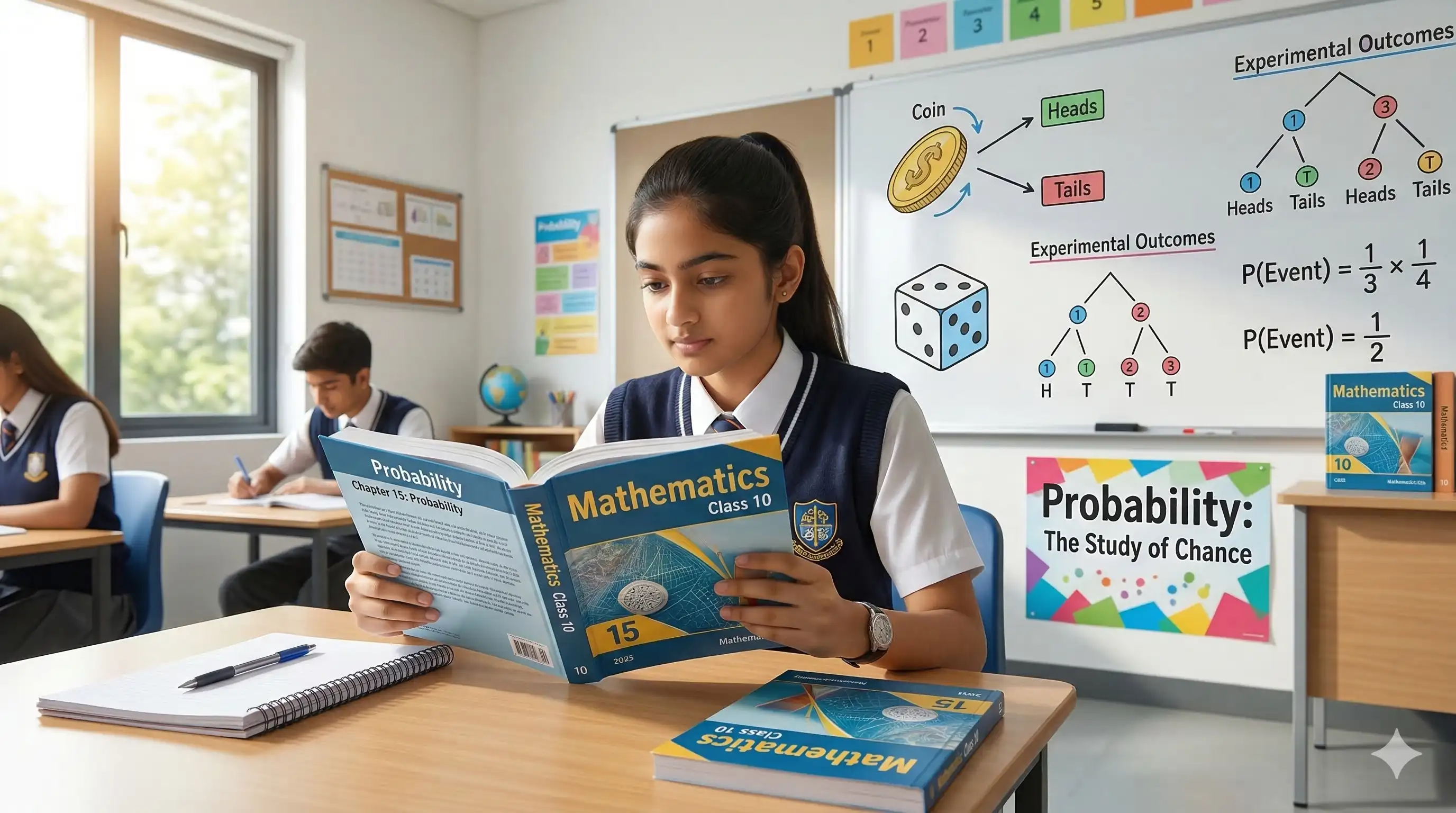
Mastering Probability for Class 10 Maths
Mastering Probability 📘
📚 1. Introduction and Core Concepts
Probability in Class 10 (CBSE/NCERT) mainly deals with empirical (experimental) probability and theoretical (classical) probability of simple events.
1. Random Experiment
An experiment is called random if:
- It has more than one possible outcome.
- You cannot predict exactly which outcome will occur, even if you know all possible outcomes.
Examples:
- Tossing a coin (outcomes: Head or Tail)
- Throwing a die (outcomes: 1, 2, 3, 4, 5, 6)
- Drawing a card from a well-shuffled deck
2. Trial and Outcome
- Each time you perform a random experiment, it is called a trial.
- The result of a trial is called an outcome.
For example, tossing a coin 10 times means you did 10 trials. Each Head or Tail you get is an outcome.
3. Sample Space and Sample Points
- The sample space of an experiment is the set of all possible outcomes.
- Each outcome in the sample space is called a sample point.
Examples:
- For tossing one coin: Sample space = {H, T}
- For throwing one die: Sample space = {1, 2, 3, 4, 5, 6}
- For tossing two coins: Sample space = {HH, HT, TH, TT}
4. Event
An event is a collection (subset) of outcomes from the sample space.
Examples:
- When a die is thrown, event “getting an even number” = {2, 4, 6}.
- When a coin is tossed, event “getting Head” = {H}.
5. Favourable Outcomes
The outcomes that satisfy the condition of an event are called favourable outcomes for that event.
Example:
- When a die is rolled, event “getting a number greater than 4” has favourable outcomes {5, 6}.
🔍 2. Detailed Breakdown & Classifications
Below are some important terms and classifications you need to remember for Class 10 Probability:
| Concept / Term | Definition & Example |
|---|---|
| Random Experiment | An experiment with more than one possible outcome, and it is impossible to predict the exact outcome in advance. Example: Tossing a coin, rolling a die. |
| Trial | Each repetition of a random experiment. Example: Tossing a coin 5 times means 5 trials. |
| Outcome | Result of a single trial. Example: Getting Head in a coin toss, or getting 4 on a die. |
| Sample Space | Set of all possible outcomes of an experiment. Example for a die: {1, 2, 3, 4, 5, 6}. |
| Event | A collection of one or more outcomes. Example: Event “getting an even number” when rolling a die = {2, 4, 6}. |
| Equally Likely Outcomes | Outcomes that have the same chance of occurring. Example: In a fair die, each of the six faces has equal chance. |
| Impossible Event | An event that can never occur. Example: Getting 7 on a standard die. |
| Sure/Certain Event | An event that is guaranteed to occur. Example: Getting a number less than 7 on a standard die. |
| Complimentary Event | If A is an event, then “not A” is its complementary event. Together they cover all possible outcomes. |
| Experimental (Empirical) Probability | Probability based on actual experiments or observations. It may change if trials increase or decrease. |
| Theoretical (Classical) Probability | Probability calculated using reasoning and known equally likely outcomes, not actual experiments. |
Now, let us look at the formulas connected to these concepts.
Theoretical (Classical) Probability of an event :
Experimental (Empirical) Probability of an event :
If is an event, then its complementary event is denoted by (or “not A”). Their probabilities satisfy:
⚙️ 3. Essential Rules, Formulas, or Mechanisms
3.1 Range of Probability
For any event :
- → Impossible event
- → Sure event
- → Neither impossible nor sure
3.2 Probability in Coins, Dice, and Cards
-
Single Coin Toss
Sample space = {H, T}
Total outcomes = 2 -
Single Die Roll
Sample space = {1, 2, 3, 4, 5, 6}
Total outcomes = 6- (prime numbers: 2, 3, 5)
-
Standard Deck of 52 Cards
- Total cards = 52
- 4 suits: Spades (black), Clubs (black), Hearts (red), Diamonds (red)
- Each suit has 13 cards: A, 2–10, J, Q, K
- Face cards: J, Q, K → 3 in each suit → 12 total
Some useful probabilities:
3.3 Using Complement to Simplify Problems
Many questions become easier if you use complementary events.
Example:
A card is drawn from a pack of 52 cards. Find the probability that it is not a heart.
- Total outcomes = 52
- Hearts = 13
Probability of drawing a heart:
So, probability of not getting a heart (complement of “getting heart”):
3.4 Word-Problem Approach (Stepwise Method)
For exam questions, follow these steps:
- Identify the experiment and write the sample space or at least the total number of possible outcomes.
- Identify the event clearly in words.
- Find the number of favourable outcomes for the event.
- Apply the formula:
- Simplify the fraction to lowest terms.
- Write the final answer clearly with proper statement.
💡 Exam-Oriented Pro Tips!
- Tip 1: Always count carefully. Most mistakes in probability happen due to wrong counting of favourable outcomes or total outcomes.
- Tip 2: Write formula first. In your answer sheet, always start with the formula of probability before substituting values. This fetches step marks.
- Tip 3: Use complement wisely. If "required event" is difficult to count, find the probability of "not required event" and subtract from 1.
- Common mistake: Students forget to check whether outcomes are equally likely before directly applying the formula of theoretical probability.
- Common mistake: Mixing up experimental and theoretical probability. Remember, experimental probability uses actual data from trials.
- Memory trick: Remember the basic formula as "favourable over total" to recall it under exam pressure.
- Presentation tip: Underline the final probability and mention whether it is simplified or not, e.g., 3/5 not 6/10.
Let us see a sample exam-style question.
Example (Dice Question):
A die is thrown once. Find the probability of getting:
(i) a multiple of 3
(ii) a number less than 3
Solution:
Sample space = {1, 2, 3, 4, 5, 6} → Total outcomes = 6
- (i) Multiples of 3 are {3, 6} → Favourable outcomes = 2
- (ii) Numbers less than 3 are {1, 2} → Favourable outcomes = 2
Example (Coins Question):
Two coins are tossed simultaneously. Find the probability of getting at least one Head.
Sample space: {HH, HT, TH, TT} → Total outcomes = 4
Event “at least one Head” = {HH, HT, TH} → Favourable outcomes = 3
So,
You can also use complement:
“At least one Head” is complement of “no Head” (i.e., TT)
📝 4. Summary & Conclusion
Probability in Class 10 focuses on simple, logical questions where understanding matters more than memorising. You have learned that:
- Probability measures the likelihood of an event, always lying between 0 and 1.
- A random experiment has uncertain outcomes; each performance of it is a trial, and the result is an outcome.
- The sample space contains all possible outcomes, while an event is a subset of this sample space.
- Theoretical probability is given by:
- Experimental probability is based on data from repeated trials.
- Complementary events are very useful and follow:
For CBSE Class 10 exams, questions are usually from:
- Tossing of coins
- Throwing of dice (single die, sometimes two dice in higher-level questions)
- Drawing cards from a well-shuffled deck
- Simple word problems from real-life situations (like defective/non-defective items, rainy days, etc.)
To score full marks:
- Understand each term clearly.
- Practice NCERT examples and exercises thoroughly.
- Avoid silly mistakes in counting and simplification.
- Always show steps clearly and write the final answer in lowest terms.
With consistent practice, Probability can become one of your strongest and most reliable chapters for securing marks.
Ready to test your knowledge?
Practice with our Maths quiz.
Take the "Class 10 Probability: Set 1" Quiz Now! 📝