
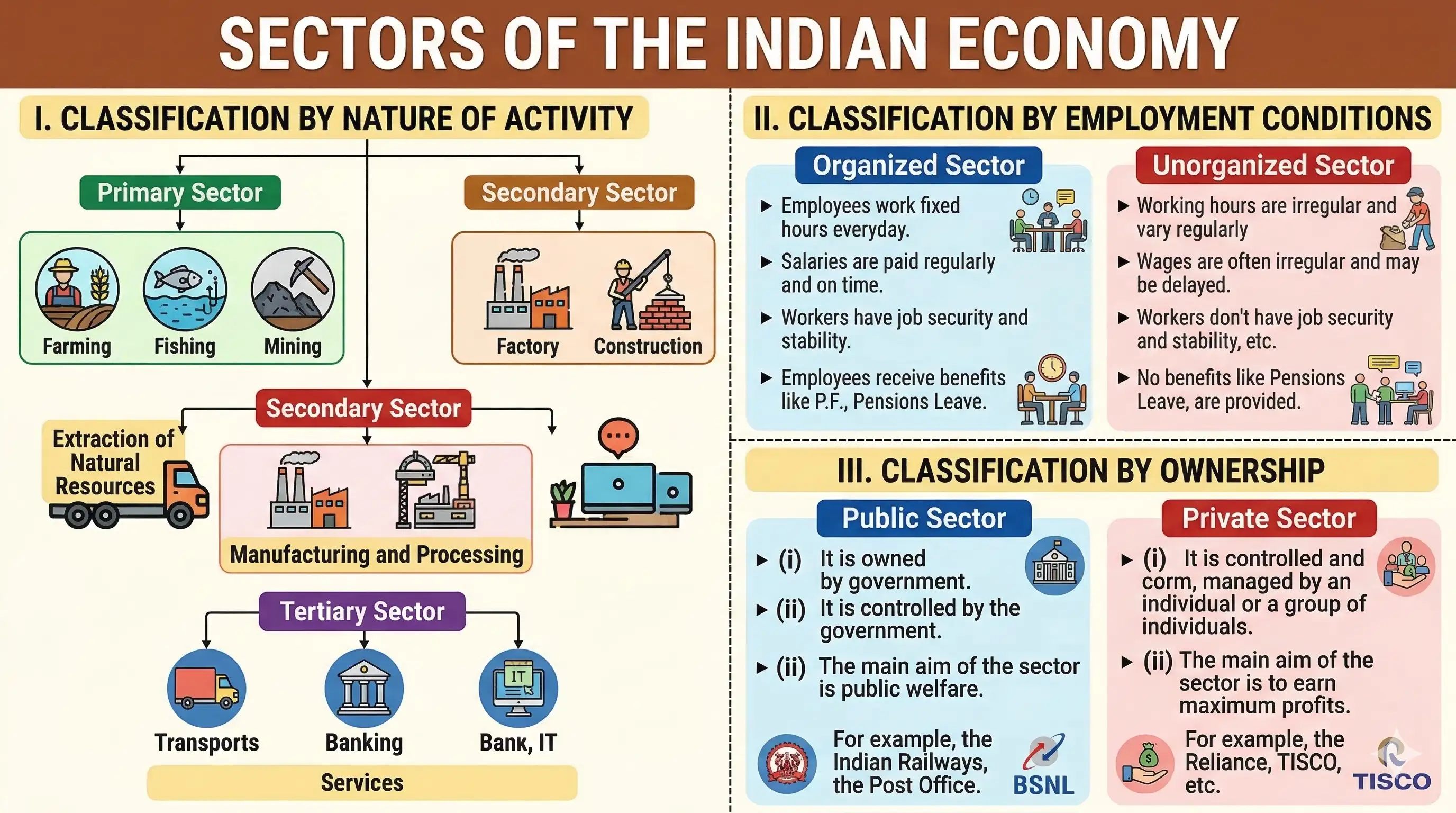
Mastering Sectors of the Indian Economy for Class 10 Economics
Mastering Sectors of the Indian Economy 📘
Questions from this chapter are asked regularly in boards as:
- Short answer questions (2–3 marks) asking definitions and differences.
- Case-based and competency questions based on real-life situations.
- Long answer questions (5 marks) asking you to explain the role and problems of different sectors.
📚 1. Introduction and Core Concepts
The Indian economy is made up of different kinds of activities. To study them easily, economists group these activities into “sectors”. In your syllabus, we mainly classify the economy in three different ways:
- On the basis of nature of activity – Primary, Secondary and Tertiary sectors.
- On the basis of who owns and controls – Public and Private sectors.
- On the basis of level of organisation – Organised and Unorganised sectors.
Economic activity means any activity that produces goods or services and earns income. For example, a farmer growing wheat, a worker making cars in a factory, a doctor treating patients – all are doing economic activities.
1.1 Primary, Secondary and Tertiary Sectors
Primary sector:
- It includes activities that use natural resources directly.
- Examples: agriculture, fishing, forestry, mining, dairy, poultry.
- Also called the agriculture and related sector.
Secondary sector:
- It includes activities that process natural products into finished goods.
- Examples: cotton textile industry, sugar mills, bakeries, steel factories, car manufacturing, oil refineries.
- Also called the industrial or manufacturing sector.
Tertiary sector:
- It includes activities that provide services instead of goods.
- Examples: transport, banking, insurance, education, health, tourism, IT services, retail shops.
- Also called the service sector.
Key idea: Primary sector forms the base (raw materials), secondary sector converts them into products, and tertiary sector supports both by providing services.
1.2 Final Goods vs Intermediate Goods
Final goods:
- Goods that are ready for use by consumers or for investment.
- Their value is counted in the national income and GDP.
- Example: Bread bought by a family for eating; a tractor bought by a farmer.
Intermediate goods:
- Goods used as inputs in further production.
- Their value is not counted separately in GDP to avoid double counting.
- Example: Wheat used by a bakery to make bread, cotton used in a textile mill.
1.3 Gross Domestic Product (GDP)
Gross Domestic Product is the total value of all final goods and services produced within a country during a year. In India, GDP is calculated mainly by the Central Government agency (earlier CSO, now NSO under MOSPI).
From this chapter’s point of view, you should know:
- GDP shows how developed an economy is.
- In India, the tertiary sector has become the largest contributor to GDP.
🔍 2. Detailed Breakdown & Classifications
2.1 On the Basis of Nature of Activities
| Concept / Term | Definition & Example |
|---|---|
| Primary Sector | Uses natural resources directly to produce goods. Example: A farmer growing rice in Punjab, a fisherman catching fish in Kerala, miners extracting coal in Jharkhand. |
| Secondary Sector | Converts raw materials from the primary sector into finished or semi-finished goods. Example: A sugar mill converting sugarcane into sugar; a textile mill making cloth from cotton. |
| Tertiary Sector | Provides useful services that support primary and secondary sectors and also people in general. Example: Transporting goods by trucks, banking services, teaching, medical services, tourism. |
| Final Goods | Goods ready for consumption or investment; counted in GDP. Example: A car bought by a family, a machine purchased by a factory. |
| Intermediate Goods | Goods used as inputs for producing other goods; not counted separately in GDP. Example: Wheat used by a bakery, cotton used in a spinning mill. |
2.2 On the Basis of Ownership: Public and Private Sector
Public sector:
- Owned, controlled and managed by the government (central, state, or local).
- Main motive: welfare of people, not profit.
- Examples: Indian Railways, Bharat Heavy Electricals Limited (BHEL), ONGC, government schools and hospitals.
Private sector:
- Owned and run by private individuals or companies.
- Main motive: earning profit.
- Examples: Reliance Industries, TCS, Infosys, private banks, private schools and hospitals.
Why do we need the public sector?
- To provide basic services at low or no cost (health, education, water, transport).
- To build heavy infrastructure (dams, roads, railways) where private sector may not invest.
- To ensure regional balance and reduce inequalities.
2.3 On the Basis of Organisation: Organised and Unorganised Sector
Organised sector:
- Registered with the government and follows rules and regulations (like labour laws, minimum wages, working hours).
- Workers get regular and secure jobs, fixed working hours, paid leave, medical and other benefits.
- Examples: Government offices, registered private companies, banks, big factories.
Unorganised sector:
- Small and scattered units which are mostly not registered.
- Workers have low wages, no job security, no fixed working hours or benefits.
- Examples: Small shops, roadside vendors, home-based workers, small workshops, casual labourers.
Problems in the unorganised sector:
- Exploitation of workers – low and irregular wages.
- No social security (no pensions, paid leave or medical support).
- Often children and women are employed at very low wages.
2.4 Employment and Underemployment
Employment: When people are engaged in productive activities and earn income.
Unemployment: When people who are willing and able to work do not find work.
Underemployment (Disguised unemployment):
- More people are engaged in work than actually required.
- Even if some people leave, production will not fall.
- Common in agriculture in rural India.
- Example: A family of 8 working on a small plot of land where only 4 people are enough. The extra 4 are underemployed.
⚙️ 3. Essential Rules, Formulas, or Mechanisms
Even though this chapter is theoretical, there are some mechanisms and logical flows you must understand clearly for exams.
3.1 How to Identify the Sector from an Activity
Ask yourself:
- Is the activity directly using natural resources? → Primary sector.
- Is it converting raw materials into other goods? → Secondary sector.
- Is it providing any kind of service? → Tertiary sector.
Example:
- A farmer growing sugarcane – Primary
- A sugar mill producing sugar – Secondary
- A shopkeeper selling sugar or a truck transporting sugar – Tertiary
3.2 Shift from Primary to Tertiary Sector
Over time, as countries develop:
- At first, most people work in the primary sector (agriculture-based economy).
- Then, industrialisation leads to growth in secondary sector.
- Finally, services like education, health, IT, banking grow rapidly and tertiary sector becomes largest.
In India:
- Tertiary sector now contributes the highest to GDP.
- But a large percentage of workers are still in the primary sector, often underemployed.
3.3 Role of Government in Public Sector
Mechanisms through which the government supports development:
- Invests in infrastructure: roads, railways, power, ports, communication.
- Provides basic services: education, health, drinking water, sanitation.
- Implements laws to protect workers in organised sector (minimum wages, safety rules).
- Runs welfare schemes like MGNREGA to provide employment in rural areas.
3.4 MGNREGA (2005) – A Key Scheme
Mahatma Gandhi National Rural Employment Guarantee Act, 2005:
- Guarantees 100 days of wage employment in a year to every rural household willing to do unskilled manual work.
- If government fails to provide work within 15 days, unemployed workers are entitled to an unemployment allowance.
- Objective: reduce rural unemployment and underemployment, create durable assets like roads, ponds, canals in villages.
💡 Exam-Oriented Pro Tips!
- Tip 1 – Learn definitions word-perfect: Questions like “Define GDP”, “What is disguised unemployment?”, “What is an organised sector?” often carry 1–2 marks. Memorise the NCERT-style definitions and add 1 example for full marks.
- Tip 2 – Use examples from the textbook: When asked “Give an example of public sector activity” or “Give an example of underemployment”, write simple, textbook-like examples (e.g., “A family of eight working on a small plot of land where only four people are needed”). Examples make your answer stronger.
- Tip 3 – Differences table: For questions like “Differentiate between public and private sector / organised and unorganised sector / primary and secondary sector”, always answer in a 3-point table format. This is neat and fetches full marks.
- Tip 4 – Case-based questions: Read the case and pick clues. If you see words like “not registered”, “no fixed working hours”, “no paid leave” – it is unorganised sector. If you see “owned by government”, “for welfare” – it is public sector.
- Common mistake to avoid: Do not mix up “largest share in employment” with “largest share in GDP”. In India, agriculture (primary sector) employs the maximum people, but services (tertiary sector) contribute the most to GDP.
- Memory trick: Remember the flow “Farm–Factory–Facility”. Farm = Primary, Factory = Secondary, Facility (services) = Tertiary. This helps you quickly classify activities in MCQs.
📝 4. Summary & Conclusion
To revise quickly for your exam, keep these key points in mind:
- The economy is divided into sectors on three bases:
- Nature of activity – Primary, Secondary, Tertiary
- Ownership – Public and Private
- Organisation – Organised and Unorganised
- Primary sector uses natural resources; Secondary sector converts raw materials into goods; Tertiary sector provides services that support both sectors and people.
- GDP is the total value of final goods and services produced in a country in a year. Tertiary sector currently contributes the highest to India’s GDP.
- India still has a large share of its workforce in agriculture, where many suffer from underemployment/disguised unemployment.
- Public sector is owned and managed by the government for welfare and development; private sector is owned by individuals and companies and aims at profit.
- Organised sector offers regular wages, job security and social security; unorganised sector is characterised by low wages, no fixed hours and lack of security.
- The government plays a vital role in providing basic services, protecting workers and running employment schemes like MGNREGA.
If you:
- Remember all key definitions,
- Can classify activities into correct sectors,
- Know 3–4 strong points for each “difference between” question,
- And can write 1–2 lines on problems and solutions (like need for more employment in secondary and tertiary sectors),
Ready to test your knowledge?
Practice with our Economics quiz.
Take the "Sectors of the Indian Economy Set-1" Quiz Now! 📝